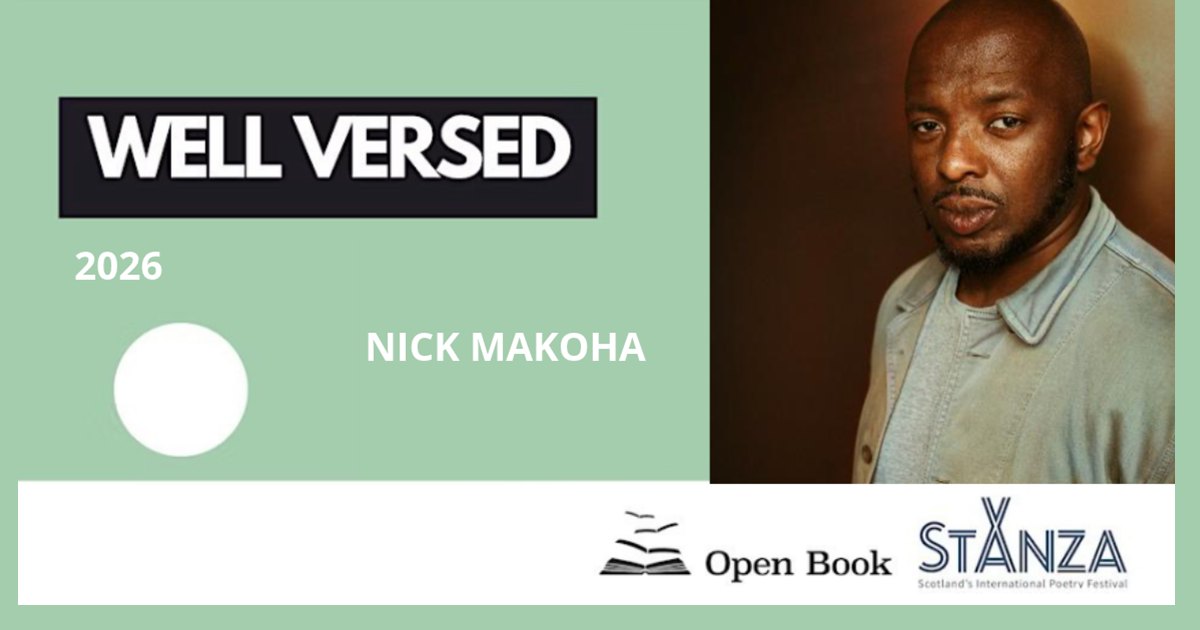
In January, the Ugandan-born poet and playwright Nick Makoha joined Well Versed, our online reading and conversation series with Open Book, ahead of his appearance at StAnza 2026 in March. Nick has been writing poetry since he was six years old, and by his own account he started because he assumed it was the normal thing to do. His debut collection, Kingdom of Gravity, was one of the Guardian's books of the year, and Penguin published his second, The New Carthaginians, in 2025. He is also the founder of the Obsidian Foundation, which works to cultivate and amplify the voices of Black poets.
Over the course of an hour, Nick Makoha read from The New Carthaginians and answered questions about the painter Jean-Michel Basquiat, the myth of Icarus, the 1976 Entebbe hijacking and the footnote poems that run through the collection. You can watch the full recording at the bottom of this post.
Nick Makoha reads from The New Carthaginians
Nick began with 'Flight', a sequence he knows by heart but read with the book in hand, as he put it, "as a prop". In the collection it follows 'Prelude', a homage to Wordsworth's autobiographical poem that he promised the Wordsworth Trust during his time there as writer in residence. 'Flight' introduces the three figures who carry the book: the poet, Basquiat and Icarus. Its sections move from a first meeting with Basquiat at two in the morning, to a face in the mirror of an Airbus bathroom, to the summer of 1976, when an Air France flight from Tel Aviv was hijacked and diverted to Entebbe in Uganda.
Later in the evening he read 'Pegasus' alongside its companion footnote poem, 'Now's the Time', and then the paired poems 'Self-Portrait 1981' and 'Self-Portrait of the Poet as Cassius Clay'. He closed with the title poem, 'The New Carthaginian', choosing what he called "the more fierce one" of its two versions. Hannibal speaks the poem, and it opens with an epigraph from Marcus Garvey.
Between poems, he noticed how much music runs underneath the collection, from Charlie Parker to D'Angelo and Stevie Wonder, all of whom surface in the poems he chose to read.
There's a soundtrack playing constantly through the book. I only just realised that now.
Nick Makoha
How much work should the reader do?
Our host opened the conversation by asking how much work he expects from readers, given the many layers of history and reference in the poems. His answer was reassuring. You can simply read the book, in the same way you might watch a film set in Madagascar without first travelling there. Researching the history will give you a richer context, but the poems do not depend on it.
What he does ask for is attention. He would like readers to take the book from cover to cover rather than dipping in and out, and he compared it to a night at the opera: nobody would step out after ten minutes for a sandwich and a phone call and still claim to have seen the performance.
What I expect of the reader is total commitment to the text.
Nick Makoha
Footnotes that carry equal weight
The footnote poems prompted much of the discussion. Basquiat often painted triptychs, and Nick wanted to find a way of making one on the page. A diptych is relatively simple, since two connected poems can sit side by side, but he was after something more ambitious. In poems like 'Pegasus', the main text and the footnotes are two separate poems, each written independently and each titled after a Basquiat painting. Read on their own, both work. Read together, line by line, they form a third poem.
When an audience member asked what the footnotes were doing, he explained that he had deliberately overturned the usual relationship between the main text and the note at the bottom of the page, where the important material sits above and the extra information below.
One thing that Basquiat did in his paintings was that all parts of the painting had equal hierarchy. So in my footnote poems, the lines have equal hierarchy. You could actually start the poem from the bottom.
Nick Makoha
For Nick Makoha, this connects directly to how Black experience is represented. He described how blackness is often reduced to caricature or stereotype, and how people tend to see the Black body as either threatening or under threat. Placing an outer and an inner voice on the same page, with neither ranked above the other, allows the poems to present that body as "a spiritual, physical being". He joked afterwards that it was the best explanation he had ever given, and asked for a copy of the recording.
A painter who poets
One participant, who has experimented with field notes alongside her own poems, asked whether it had felt brave to bring such an unconventional book to his editors. Nick Makoha said that it had. After Kingdom of Gravity he knew he needed to take a bigger leap, and he wanted to tell his own story with a vulnerability that cleverness with language can sometimes hold at arm's length. The collection went through several titles along the way, beginning as The Welcome Table and then becoming Codex before it settled on The New Carthaginians.
I think Basquiat is a poet that paints. And I'm a painter who poets.
Nick Makoha
He described the book as a mural in three parts, which together work as a kind of triptych, and called it his "failed attempt at making a long poem" that became a painting instead. He was open about how many ideas did not survive the process, including some footnote poems, some of the codex poems and an entire first version of one section. In his words, the finished book is "the maturation of failed ideas".
Why Nick Makoha turned to Basquiat
Nick Makoha first saw Basquiat's work at the Barbican's Boom for Real exhibition, and wept in front of the very first painting. It was an uncomfortable experience that he tried to keep under control, but it told him something important about what he wanted his own writing to do.
Whatever had me go beyond my own defences and be open enough to cry in that moment was the same frequency I wanted the book to be delivered in.
Nick Makoha
He was clear that choosing Basquiat was never premeditated. A friend later pointed out that he had been sketching Basquiat's images on his work for years without noticing. What the painter offered was a way into a problem. Basquiat once said he wanted to pull the whole of history onto the canvas, and Nick needed a way to tell a Ugandan story across several timelines to Western readers who might not expect a modern African story at all.
The spine of the book is the Entebbe hijacking, which lasted seven days. It continues a thread that runs through his work: Kingdom of Gravity looked at Uganda under Idi Amin between 1971 and 1979, and his play The Dark follows the single day on which his mother smuggled him out of the country, a structure he took partly from Spike Lee's Do the Right Thing. Rather than simply describing Basquiat's paintings, he set his emotional response to them against what he called the mural of his own life, an approach he described as "double ekphrasis".
Icarus, myth and time
Icarus arrived through several routes. Basquiat painted Icarus Esso, Icarus appears in Virgil's Aeneid, and critics often described Basquiat himself as an Icarus figure who flew too close to his ambition. Above all, Nick explained, a myth gives readers something familiar to hold on to. As he put it, "a lot of Black experience just goes erased. But myths, people know."
Asked whether Icarus and Basquiat were really versions of himself, he said that they were not at first, but that he has come to see them as different sides of his own nature, and as a way of looking at maleness more vulnerably. They also allowed him to weave together Basquiat's time, historical time, mythical time and the time we live in, so that the story moves backwards, forwards and sideways. Readers often tell him the book takes them everywhere, which he said was exactly its job: to show that "the world I live in is bigger than the world you perceive I live in".
Letting the poem find its own form
Susanna asked whether he lets fury find its own form or chooses a form in which to contain it. Nick said he never decides on form in advance. When he begins a poem, the first line is the only line he knows he is going to write, and everything after it is discovered in the writing. He compared planning a poem too closely to announcing at the age of ten exactly whom you would marry and on which day of the week.
Creativity is totally the opposite of that. It's out of control. That's where possibility is.
Nick Makoha
Fury, in that sense, is less a subject than something he tries to look beneath. Anger often masks another emotion, and his process involves asking what a word or a feeling really meant. He thinks this is why readers respond to the book, since its emotions sit close to the surface, but he worked hard to express them without sarcasm.
Towards the end of the evening he was asked about language. Nick grew up speaking four languages, including Luganda and Samia, and is now relearning Swahili. He still writes in English, which he said is hard enough on its own, but he feels that whatever those languages held now finds its way into his poetry.
Watch Nick Makoha at Well Versed 2026
The full reading and conversation is below. You can also watch it on YouTube as part of the Well Versed playlist, and find out more about Nick on his StAnza artist page.
Well Versed is our series of online readings and conversations with Open Book. Many thanks to Nick, and to everyone who came along with such thoughtful questions.